Hurricane season ends in
Cayman Storm Ready
Cayman Storm Status · Live
No Active Storms Atlantic season · 1 Jun – 30 Nov

No Cayman Islands storm flag is currently flying. Stay ready — check back here through the season.

Checking the latest NOAA / National Hurricane Center outlook…

Cayman Islands · Hurricane Season 1 June – 30 November

Before the wind arrives, be ready.

A community preparedness guide for Grand Cayman, Cayman Brac and Little Cayman — built around the National Tropical Storm & Hurricane Plan, Hazard Management Cayman Islands (HMCI) guidance and the national warning-flag system. Know your risks. Make a plan. Get a kit. Stay informed.

Flags are hoisted at post offices, police and fire stations and other designated sites across all three islands when a storm threatens.

Stay Informed · Live Sources

The Weather Desk

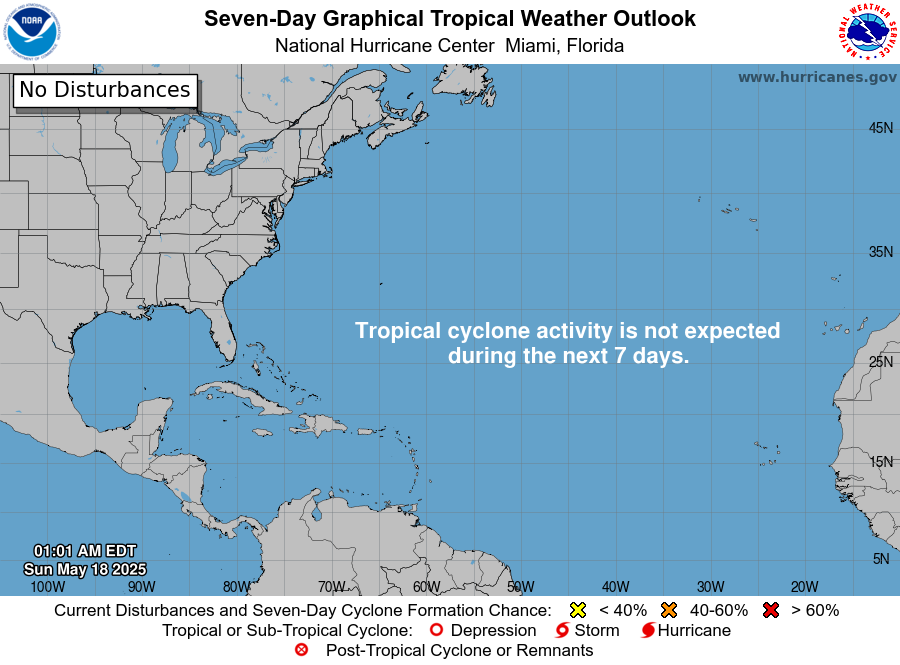
Watch the tropics the way forecasters do: start with the Cayman Islands National Weather Service for local advisories, the National Hurricane Center for the big picture, and Weather Underground for model runs and tracking maps. The images below update automatically from NOAA.

Auto-updating · NOAA/NHC

Atlantic 7-Day Tropical Outlook

National Hurricane Center 7-day graphical tropical weather outlook for the Atlantic basin

Source: National Hurricane Center, Miami. Yellow / orange / red areas show 7-day development chances. Refresh the page for the latest issue.

Auto-updating · NOAA GOES-East

Caribbean Satellite (GeoColor)

Latest GOES-East GeoColor satellite image of the Caribbean sector, including the Cayman Islands

Source: NOAA STAR, GOES-East Caribbean sector. The Cayman Islands sit south of Cuba, north-west of Jamaica.

Official · Local

Cayman Islands National Weather Service

The national authority. Alerts, Watches, Warnings and the All Clear for the Cayman Islands are declared by the CINWS Director General with HMCI. Local forecasts, radar and marine advisories.

Official · Regional

National Hurricane Center (NOAA)

Track forecasts, cones, wind-arrival timing and storm-surge guidance for every Atlantic system. When a storm has a name, this is where the advisories live.

Independent

Weather Underground

Hurricane and tropical-cyclone tracking with interactive maps, model comparisons and station data — a useful second screen alongside the official sources.

Rule of thumb: independent trackers and YouTube are great for understanding a storm — but decisions (shutter, shelter, evacuate) follow the official CINWS / HMCI declarations, broadcast on Radio Cayman, gov.ky, weather.gov.ky and the National Emergency Notification System.

The Science

What Is a Storm?

A hurricane doesn’t arrive fully formed — it grows. Forecasters rank it by its maximum sustained wind (the one-minute average), from a tropical depression up to a Category 5 hurricane on the Saffir–Simpson scale. Knowing the category tells you what the wind can do. Just never forget the water.

TD

Tropical Depression

up to 38 mph · 61 km/h

A closed circulation, not yet named. Winds are modest, but heavy rain and flooding are already possible.

TS

Tropical Storm

39–73 mph · 63–118 km/h

Now it gets a name. Dangerous winds, heavy rain, rip currents and some flooding. All outdoor activity should stop once winds reach 39 mph.

1

Category 1 Hurricane

74–95 mph · 119–153 km/h

Very dangerous winds — some damage.

Damage to roofs, shingles, siding and gutters; large branches snap; some power lines down, with outages lasting a few days.

2

Category 2 Hurricane

96–110 mph · 154–177 km/h

Extremely dangerous winds — extensive damage.

Major roof and siding damage; many trees snapped or uprooted; near-total power loss for days to weeks.

3

Category 3 Hurricane Major

111–129 mph · 178–208 km/h

Devastating damage.

Roof decking and gable ends can be torn away; many trees block roads; power and water out for days to weeks.

4

Category 4 Hurricane Major

130–156 mph · 209–251 km/h

Catastrophic damage.

Loss of most of the roof structure and some exterior walls; neighbourhoods cut off; power out for weeks to months; homes uninhabitable for weeks.

5

Category 5 Hurricane Major

157 mph+ · 252 km/h+

Catastrophic damage.

A high percentage of homes destroyed, with total roof failure and wall collapse; most of the area uninhabitable for weeks to months. Ivan struck Cayman here in 2004.

Wind is only half the story. The Saffir–Simpson scale measures wind only — it leaves out storm surge, rainfall flooding and tornadoes, which are often the deadliest part of a storm. In Cayman, it was Hurricane Ivan’s 8–10 ft storm surge, not the wind alone, that put most of Grand Cayman underwater. A “lower” category that stalls overhead or strikes at high tide can still be catastrophic. See why we prepare →

Two more things worth knowing: potential wind damage roughly quadruples with each category, so a “small” jump in winds is a big jump in danger — and category is strength, while the Cayman flag system is timing. You need to read both.

The Track Record

How Often Does This Happen Here?

The Cayman Islands National Weather Service keeps an official record of every storm whose centre has passed within 75 statute miles of Grand Cayman, Cayman Brac or Little Cayman since 1852. Here’s what 170 years of records show — and, just as importantly, what they can’t tell you.

77Documented direct hits
1852–2021
~2.2 yrsAverage gap between
direct hits (all strengths)
12%Of direct hits were major
hurricanes (Cat 3+)
79%Of direct hits struck in
Aug, Sep or Oct

When storms are most likely

Of the 77 documented direct hits, month-by-month:

Late August through October is historically the highest-risk stretch — this is when most preparation should already be finished, not started.

How strong, when they hit

Storm category at closest approach, across all 77 direct hits:

Tropical storm35 · 45%
Category 125 · 32%
Category 28 · 10%
Category 3 Major4 · 5%
Category 4 Major5 · 6%

Most direct hits arrive as tropical storms or Category 1–2 hurricanes. Major hurricanes (Cat 3+) are the minority — but they include the two most consequential storms in Cayman’s record: the 1932 storm (Category 4, the deadliest, with 109 lives lost) and Hurricane Ivan in 2004 (Category 5, the costliest — see Why We Prepare).

What these numbers don’t tell you. A historical average describes the past — it is not a forecast, and it cannot tell you what this season, or any single year, will bring. Hurricane forecasters put it plainly: it only takes one storm making a direct hit to make a season a bad one for the islands, no matter how quiet the rest of the season was. Treat every season as the one that might be that year.

Reading these numbers responsibly

  • “Direct hit” is a specific, narrow definition — a storm centre passing within 75 statute miles of one of the three islands, per CINWS’s own published criteria. Many more storms have passed farther out and still brought damaging surge, swells, rain-flooding or wind to the islands without meeting this threshold.
  • Older records carry more uncertainty. Storms before the satellite era (pre-1960s), and especially before organised record-keeping began in the 1850s, were tracked from ship reports and land observations. Their counts, tracks and intensities are considered less precise than storms recorded in the modern era.
  • A 170-year average blends very different climate eras. It smooths over decade-to-decade and cycle-to-cycle variation — some multi-decade stretches are quieter, others far more active, than the long-run average shown here.
  • For this year specifically, don’t rely on a historical average — check the current seasonal outlook and impact probabilities, which meteorologists recalculate every year from current ocean and atmospheric conditions.

The Reminder

Why We Prepare

Preparedness can feel abstract — until you remember what a storm has already done here. For the Cayman Islands, that memory has a name: Ivan.

On 11 September 2004, Hurricane Ivan passed just south of Grand Cayman as a Category 5 — sustained winds of about 155 mph, gusts up to 217 mph, a storm surge of 8–10 feet and waves of 20–30 feet. Most of Grand Cayman sat underwater for two days.

Two people lost their lives, around 6,500 people sheltered, and the damage reached roughly US$3 billion. Nearly every home and business was hit; power, water and communications were gone for weeks to months, and many residents left the island to recover. It remains the storm against which Cayman measures every other — and the direct reason Hazard Management Cayman Islands, the modern shelter system, stronger building codes, and plans like the one on this site exist today.

Twenty years on, the lesson is simple: the islands came back because people prepared, sheltered, and helped one another. Preparation is what makes Ivan a story of resilience, not only of loss. That is why we get ready — every single season, before the wind arrives.

5Hurricane category
155 mphSustained winds
8–10 ftStorm surge
6,500People sheltered
US$3BIn damage

The National Notification System

Know the Flags

The Cayman Islands uses a four-stage notification system — Alert, Watch, Warning, All Clear — declared by the National Weather Service with HMCI and broadcast on Radio Cayman and official channels. Each stage is a countdown clock. Here’s what each one means, and what your household should be doing.

Alert

72+ hours out · Storm likely to strike

Issued when a tropical storm or hurricane is likely to affect the Cayman Islands within roughly 72 hours or more. HMCI activates the national plans. This is your decision and top-up window — roads and shops are still calm.

  • Decide your plan now: stay at home, go to a public shelter, stay with friends or family in a safer building, or leave the island. Discuss it as a household while options are open.
  • Top up your emergency kit — water, food, batteries, first aid — before the rush. Refill prescriptions to a two-week supply.
  • Fuel both vehicles and any jerry cans; withdraw cash in small bills (ATMs and card machines fail with the power).
  • Call your off-island contact and confirm they’ll act as the family’s communications hub.
  • Photograph or video your home and contents, room by room, for insurance. Scan key documents to email or cloud storage.
  • Book flights early if anyone plans to leave — seats disappear fast once a Watch is declared.
  • Confirm arrangements for pets. Public shelters cannot take animals, so pets need a plan of their own.

Watch

48 hours · Storm conditions possible

One red flag with a black centre. Issued 48 hours before tropical-storm or hurricane-force winds are possible. Shelter teams prepare their buildings, evacuation of Little Cayman may begin, and a decision is taken on closing schools. This is your physical preparation window.

  • Put up shutters, or fit and check them now — never wait for the Warning to discover a missing bolt or track full of sand.
  • Clear the yard: patio furniture, plant pots, toys, garbage bins, coconuts — anything that can fly. Strap down what can’t come inside (propane tanks, A/C condensers, sheds).
  • Boat owners: haul out, trailer inland, or move to safe moorings — vessels are advised to seek safe harbour well before conditions arrive.
  • Fill water storage: food-safe containers for drinking, plus buckets, coolers and the washing machine for utility water. Freeze bottles of water — they keep food cold and become drinking water later.
  • Move vehicles to the highest ground available to you; don’t leave them near canals, the ironshore or under trees.
  • Move electronics, photographs and documents up high and into waterproof bags or bins. Charge every device and power bank.
  • If you’re going to a shelter or to friends, pack the grab-and-go bags now and plan to move during the Watch, not the Warning.

Warning

36 hours · Storm conditions expected

Two red flags with black centres. Issued 36 hours before tropical-storm or hurricane-force winds are expected. Public shelters open, and Radio Cayman broadcasts bulletins at least every half hour. Finish everything, then get where you’re riding it out — and stay there.

  • If you’re going to a public shelter, go now — arrive early with your bedding, food, water, medication and documents. Shelters provide a safe roof, not full board.
  • Set fridge and freezer to coldest, fill the bathtub for sanitation water, and turn off propane at the tank if advised.
  • Choose your safe room: an interior room or hallway with no windows, on the highest floor that is still protected from wind — but never the ceiling void or roof space in a surge zone home unless flooding forces you up.
  • Put shoes, flashlight, whistle, power bank and documents inside the safe room with you.
  • Stay off the roads once winds build. All outside activity ceases when sustained winds reach 39 mph — after that, emergency services cannot reach you until conditions ease.
  • Check on elderly neighbours and anyone who lives alone before conditions deteriorate.

During the Storm

Shelter in place · No flag — nobody is outside to see one

Winds above 39 mph mean you are on your own until the All Clear. The goal is simple: keep everyone away from wind, water and glass.

  • Stay inside, away from windows and glass doors — even shuttered ones. Keep to your safe room during the worst of it.
  • Beware the eye. If the wind suddenly drops calm, the storm is not over — the back half arrives from the opposite direction, often within minutes to an hour. Stay inside.
  • If water enters the house, move up — onto counters or a second storey — but avoid enclosed attic spaces you can’t escape from.
  • Keep the radio on Radio Cayman for bulletins. Use phones sparingly to preserve battery.
  • Eat regular meals and keep children on a normal eating and sleeping rhythm as much as possible — it steadies energy, blood sugar and nerves in a long, frightening night.
  • Never go outside “to check” — flying debris and live wires are the biggest killers in a hurricane.

All Clear

Declared officially · Green flag

The green flag means the storm no longer threatens the islands — not that it’s safe everywhere. Search, rescue and road clearance begin; damage assessment starts. The days after a storm cause many of its injuries.

  • Wait for the official All Clear on Radio Cayman or official channels before going out. A lull is not an All Clear.
  • See the full After the Storm section below — downed lines, contaminated water, generators and debris each have their own rules.

In the Moment

What to Do If…

Most guides tell you what to buy. This one tells you what to do when something actually goes wrong — search a situation or filter by phase. For anything life-threatening, call 911 first, then work the steps.

General guidance compiled from HMCI, CINWS and CUC advice — always follow official instructions and emergency-responder directions on the day. Life-threatening emergency? Call 911.

Make a Plan

The Family Plan

A kit without a plan is just heavy shopping. The national family-plan template asks every household to settle these things before June — write the answers down, keep a copy in the kit, and walk every member of the household through it.

Printable · Fillable PDF

Download the Family Emergency Plan

A ready-to-print template covering everything below: household members, medications, your off-island contact, meeting points, your hurricane plan, pets, key numbers, insurance and a readiness checklist. Print it, fill it in by hand, and keep copies in the kit and with your off-island contact.

Decide Where You’ll Be

  • Pick your primary option: stay home, public shelter, private shelter, a friend’s stronger home, or leave the island.
  • Pick a backup — what if the storm strengthens, or your first option falls through?
  • Honestly assess your home (use the risk check below): elevation, flood exposure, construction, windows, trees around it.
  • If anyone in the household has medical needs, factor in access to power and care.

The Off-Island Contact

  • Name one relative or friend overseas as the family’s communications hub — local networks jam or fail; overseas lines often work first.
  • Everyone in the family memorises or carries that number and checks in through them if separated.
  • Agree how you’ll contact each other (calls, WhatsApp, SMS) and where you’ll reunite if split up — at school, at home, or elsewhere.
  • Give the contact a copy of your plan, key documents and policy numbers.

The Paper Trail

  • Seal in a waterproof bag: passports, birth certificates, insurance policies, land/lease papers, prescriptions, pet vaccination records, and some cash.
  • Scan or photograph everything to email and cloud storage — a soaked bag shouldn’t end your paperwork.
  • Write an emergency numbers sheet: 911, police, fire, hospital, vet, CUC, water, phone provider, insurer/broker, schools, employer.
  • List everyone’s medications, doses and doctors on one page.

Plan for Pets

  • Public shelters cannot accept pets — so a household with animals is usually a shelter-in-place household, or needs a pet-friendly private arrangement.
  • Prepare a pet kit: food and water for the same number of days as the family, carriers, leads, litter or bedding, medications, and vaccination records.
  • Bring animals indoors well before conditions deteriorate; never leave pets tied outside or in vehicles.
  • Photograph your pets and make sure tags/microchip details are current in case you’re separated.

Secure the Home

  • Fit rated shutters or panels for every opening — doors and sliders included, not just windows. Test them each May.
  • Strap down propane tanks, A/C condensers, sheds and water tanks; identify everything in the yard that must come inside.
  • Trim trees away from the roof and lines early in the season — not during a Watch when green waste can’t be collected.
  • Know where and how to shut off electricity, water and gas.

Talk It Through

  • Walk children through the plan calmly: what the flags mean, where the safe room is, what the noise will be like. Knowledge shrinks fear.
  • Assign jobs — who packs the pet kit, who handles shutters, who checks on grandma — so nobody is idle or duplicated.
  • Plan for the emotional side and the boring side: books, cards, games, comfort items for a long night without power.
  • Agree the post-storm rules with kids in advance: no wading in floodwater, no touching wires, shoes on at all times.
Season rhythm: review the plan, the kit, the shutters and your insurance cover every year before 1 June — and again whenever your household changes (a new baby, a new pet, a child changing schools, a house move).

Know Your Risks

Check Your Home’s Threat Level

The Cayman Islands are low-lying — much of Grand Cayman sits only a few feet above the sea, and in Hurricane Ivan (2004) storm surge and flooding reached deep inland. Answer eight questions about where and how you live to see your home’s surge & flood and wind exposure, with actions matched to your situation.

How close is the nearest salt water — sea, sound or canal?
Roughly how high is your ground floor above sea level?
How many storeys?
Main structure
Roof
Storm protection on windows and doors
Immediate surroundings

Your Exposure

Storm surge & flooding
Wind & debris

This is a planning aid, not a forecast. Every storm is different — surge depends on the storm’s track, size and angle of approach. Official HMCI hazard maps and any evacuation order always override this tool. See caymanprepared.ky for official hazard information.

Get a Kit

Supplies Calculator

After a major hurricane, expect no mains power, no piped water, closed shops and limited fuel — Ivan left parts of Grand Cayman without services for weeks. Enter your household below. The calculator sizes water, food and pet supplies to your family, then lists everything else your kit needs.

Your household
Adults
2
Including teens 13+
Children
2
Ages 2 – 12
Infants
0
Under 2 — adds formula & nappies
Dogs
0
Cats
0
Small pets
0
Birds, turtles, gerbils, rabbits…
Prepare for how many days?

Three days is the absolute floor. After a direct hit on a small island, water, power and shops can take far longer — a week is the sensible baseline, two weeks is real resilience.

Your Kit, Sized

Power, Light & Comms

  • Battery or hand-crank radio — your lifeline to Radio Cayman when the cell network fails
  • One flashlight or headlamp per person + spare batteries for everything
  • Power banks, charged; car chargers and cables
  • Generator or portable power station if you can — run generators outdoors only, far from windows
  • Fuel: full vehicle tanks + stabilised jerry cans stored safely; propane for cooking
  • Lanterns and glow sticks — avoid candles (fire risk in wind-damaged homes)

Health & Sanitation

  • First aid kit + any personal medical devices
  • Two weeks of every prescription, in a labelled waterproof bag
  • Unscented household bleach + dropper for water treatment (8 drops per gallon of clear water, wait 30 min)
  • Heavy garbage bags, wet wipes, hand sanitiser, soap, toilet paper
  • Mosquito repellent and nets — mosquitoes surge after flooding
  • Sunscreen, work gloves, sturdy closed shoes for everyone, whistle per person

Grab-and-Go Bags

  • One small bag per person, packed by the Watch, ready if you must move fast
  • Documents bag (waterproof), cash, phone + power bank, keys
  • Change of clothes, rain jacket, closed shoes
  • Snacks, water bottle, personal meds, glasses
  • Kids: comfort item, small games; Infants: formula, bottles, nappies
  • Pets: carrier, lead, food, bowl, vaccination card

Build Up In Stages

Basic, Intermediate & Advanced

Three levels that build on each other — start with Basic and work up as far as you can. A week (Intermediate) is the sensible baseline for a small island; two weeks (Advanced) is real resilience. Quantities scale with your household, so size water and food with the calculator above.

● Level 1

Basic

3 days · grab-and-go ready
  • Water — 1 gal per person per day, 3 days (include pets)
  • 3 days of no-cook non-perishable food + manual can opener
  • Flashlight/headlamp per person + spare batteries
  • Battery or hand-crank radio; charged power bank + cables
  • First aid kit; 2 weeks of medications in a waterproof bag
  • Documents (IDs, insurance, policy numbers) sealed & photographed; cash in small bills
  • Hygiene items, whistle, closed shoes & a change of clothes each
  • Pet carrier, food, water, meds & vaccination record
● Level 2

Intermediate

7 days · shelter-in-place

Everything in Basic, plus:

  • Water & food scaled to 7 days for all, pets included
  • Cooler + ice packs / frozen bottles to stretch fresh food
  • Camp stove or gas burner + fuel; lighter & matches
  • Extra batteries, lanterns, glow sticks (avoid candles)
  • Tool kit, work gloves, duct tape, tarpaulin, rope
  • Bleach + dropper for water treatment; heavy garbage bags; bucket
  • Mosquito repellent & nets; fire extinguisher
  • Games & comfort items for kids; laminated family plan
● Level 3

Advanced

14 days · full resilience

Everything in Intermediate, plus:

  • Water & food scaled to 14 days; water filter or purification tablets
  • Generator or power station + safely stored fuel (run outdoors only)
  • Solar charger; NOAA weather radio + a spare radio
  • Chainsaw + fuel & safety gear (if trained); handsaw
  • Plywood/window film, screws, sealant, roofing patch materials
  • Ladder, heavier tools, tie-down straps
  • Portable toilet / sanitation setup for a long outage
  • Document backups (USB + cloud); N95 masks, eye protection, heavy gloves

Where to Buy

Local Stores & Vendors

Store hours and stock can change without notice, and every one of these gets extremely busy in the 48 hours before a Watch or Warning. Shop early in the season, not the week of. Call ahead if you’re after something specific like plywood, a generator, or propane.

Hardware & Building Supplies

A.L. Thompson’s
George Town (189 North Sound Road) & Savannah
Lumber, plywood, hurricane shutters & hardware, generators, propane appliances, tools.
(345) 949-8622

Warehouse & Bulk Stores

Cost-U-Less
Governors Square, West Bay Road
Bulk groceries, water, batteries and general merchandise.
(345) 745-5377
Priced Right
Airport Centre (George Town) & Republix Plaza (West Bay)
Bulk groceries, electronics, small appliances, household goods.
(345) 815-1070

Supermarkets — Grand Cayman

Foster’s Food Fair / IGA
5 locations: Airport Centre, Camana Bay, Republix Plaza (West Bay), Countryside (Savannah), Foster’s Express (East End)
The island’s largest chain — a location within reach almost anywhere on Grand Cayman.
Kirk Market
George Town / Seven Mile Beach corridor
Full grocery plus a butcher and bakery counter.
Hurley’s Marketplace
Grand Harbour, Red Bay
Full-service grocery with deli, bakery and butcher.
ShopRight
Multiple locations: Walkers Road, Cannon Place/Industrial Park, East End (opposite Health City), Windjammer Plaza
Several locations open Sunday — useful if you’re topping up last-minute.
Bay Market
Camana Bay (Foster’s specialty division)
Organic and specialty groceries.

Cayman Brac & Little Cayman

The Sister Islands have far fewer options than Grand Cayman — plan to bring specialty items with you, and stock up early since shipping delays are common in the run-up to a storm.

Kirkconnell Supermarket
Cayman Brac, West End area
Grocery, deli counter, basic hardware supplies and small appliances.
Village Square Supermarket
Little Cayman
One of the only reliably stocked grocery and basic-hardware spots on the island.
Printable · Checklist PDF

Download the Supplies Checklist

All three levels as a print-and-tick checklist for the fridge or the go-bag — with the water and food rules, and each level building on the last.

If Home Isn’t Safe

Official Public Shelters

If your home isn’t safe enough to ride out a storm, the Government opens Class ‘A’ public shelters — prepared during a Watch and opened at the Warning. The list of shelters, Emergency Medical Centres and pet-friendly locations is maintained by HMCI and can change each season and from storm to storm, so always check the official page for the current locations and which ones are open.

Official · HMCI

Find your nearest shelter

The official CaymanPrepared shelters page lists every public shelter by district, the Emergency Medical Centres, the pet-friendly shelters and exactly what to bring — kept current for each season and storm.

Bring your own kit — and plan for pets. Shelters provide a safe structure, basic facilities and management, not full board. Bring bedding, food, water, medication, documents and quiet activities for children. Most shelters cannot take pets — only a few designated pet-friendly shelters accept cats and dogs, under strict rules, so confirm on the official list and arrange pet care before you go.

Government sheltering prioritises older persons, persons with disabilities, hospital patients, essential workers and their families — but nobody who needs a safe roof is turned away while space allows. Shelter openings are announced storm by storm on Radio Cayman and official channels, so check the official list above before you set out. Evacuation of Little Cayman to the larger islands may be ordered ahead of a severe storm — take it early, while flights and boats can still run.

Who to Call · Save These Now

The Numbers That Matter

Save these in every phone in the household today — and write them on the paper plan in your kit, because a dead phone knows no numbers. Report faults to the right agency and keep 911 clear for genuine emergencies.

All emergencies · Police · Fire · Medical · All three islands 911

Emergency & Crisis

Police · Fire · AmbulanceAlso the divers’ recompression chamber911
Hazard Management (HMCI)Hurricane emergency operations945 4624
Emergency Information Hotline946 3333
RCIPS HeadquartersPolice non-emergency244 2900
Cayman Islands Red CrossShelter support, first aid, family tracing & post-storm relief949 6785

Hospitals & Medical

George Town Hospital (HSA)949 8600
HSA Accident & Emergency244 2796
Doctors Hospital (CTMH)949 6066
Faith HospitalCayman Brac948 2243
Little Cayman Clinic948 0072
District health centresWest Bay 949 3439 · Bodden Town 947 2299 · North Side 947 9525 · East End 947 7440

Power & Water

CUC — Caribbean UtilitiesGrand Cayman · faults & downed lines945 1282
Cayman Brac Power & Light948 4224
Water Authority — CaymanPiped water, sewerage & trucked water949 2837
Cayman Water CompanyWest Bay & Seven Mile service area · 24-hr emergencies945 4347

Phone & Internet

FLOWMobile, landline, internet & TV1 800 804 2994
DigicelOr dial 100 from a Digicel mobile623 3444
LogicInternet, TV & home phone946 LOGIC (5644)
C3 Pure FibreInternet, TV & home phone333 3333

Report downed poles and cables to your provider — and treat every fallen line as live until proven otherwise.

Your Insurance

Claims start with details most people can’t find after a storm. Fill this in before 1 June — from your policy schedule — and keep a copy in the documents bag.

Insurer
Policy number
Claims line
Broker / agent
Windstorm deductible

Home insurers writing property cover locally include Cayman First, Island Heritage, Britcay (Colonial Group), Sagicor and Guardian General (via local brokers) — your claims line is on your policy schedule.

Sister Islands & Your Own List

Cayman Brac Police948 0223
Cayman Brac Fire948 1245
Brac District Commissioner948 2651
Little Cayman Police948 0083
Little Cayman Fire948 0011
Off-island contact
Vet / kennel
School(s)
Employer
Check before the season: these numbers were verified against local directories and provider websites as of mid-2026, but organisations do change them. Confirm your key numbers each May, save them to every phone, and keep the printed copy in the kit — the print button in the supplies calculator prints this page’s directory too.

All Clear ≠ All Safe

After the Storm

More people are hurt after hurricanes than during them — by live wires, floodwater, carbon monoxide, chainsaws and falls. The green flag starts the recovery; these rules keep your family out of the casualty count.

Water & Power

  • Treat all tap, cistern and well water as contaminated until authorities say otherwise — boil 1 minute, or use 8 drops of unscented bleach per gallon and wait 30 minutes.
  • Assume every downed line is live. Stay well back and report it — never drive over lines or through water touching them.
  • Generators kill quietly. Run them outdoors only, well away from windows, doors and vents — never in a garage, even with the door open.
  • When power returns, check for the smell of gas and for wet wiring before switching things back on.

Floodwater & Debris

  • Stay out of floodwater — it hides sewage, chemicals, sharp metal, holes and sometimes wildlife. Keep children and pets out completely.
  • Never drive through flooded roads; the ironshore and washed-out edges are invisible under brown water.
  • Wear gloves, closed shoes and eye protection for cleanup. Chainsaws and ladders cause a wave of post-storm injuries — work rested, not rushed.
  • Dump standing water around the home within days — mosquito numbers explode after flooding.

Home & Insurance

  • Photograph all damage before you touch anything, then make only the temporary repairs needed to prevent further loss (tarps, board-ups) and keep every receipt.
  • Notify your insurer or broker as soon as you can; ask about additional living expense / alternative accommodation cover if the home is uninhabitable.
  • Beware spoiled food: when in doubt, throw it out. A fridge keeps food safe ~4 hours without power; a full freezer ~48 hours unopened.
  • Check on neighbours — especially the elderly and anyone alone. Recovery is a community sport.
Listen before you move: Radio Cayman broadcasts the All Clear, curfew information, road status, shelter and relief-service updates. Roads must first be cleared for emergency services — sightseeing traffic slows rescue.

Mind & Mood · For the Whole Family

Staying Mentally Ready

Storms test more than buildings. Fear before, stress during, and low mood or grief after are all normal and expected — and a few simple habits protect your mind the way shutters protect your home. Here is how to steady yourself, your family and your children through it.

● Before

Prepare Your Mind

Turn worry into action
  • Preparation is the antidote to helplessness — a finished plan and kit genuinely lower anxiety. Work through the plan and checklists; ticking boxes calms the mind.
  • Control what you can, and let go of what you can’t. You can’t steer the storm — only your readiness for it.
  • Ration the news. Check official updates a few times a day, not every few minutes; endless scrolling feeds dread.
  • Talk about it. Name your worries with family and share the load — spoken fears shrink.
  • Protect the basics — sleep, food, water — before conditions arrive. A rested brain copes far better.
  • Learn a calming tool now: box breathing (in 4, hold 4, out 4, hold 4) and 5-4-3-2-1 grounding (name 5 things you see, 4 you feel, 3 you hear, 2 you smell, 1 you taste).
● During

Stay Steady

Small steps, calm breaths
  • Keep routines. Regular meals, water and a normal sleep rhythm as far as possible steady everyone’s mood and energy (and blood sugar for the kids).
  • Shrink the task. Focus on the next small thing, not the whole storm.
  • Breathe and reassure. Slow breathing calms your body — and everyone watching you, because children read your face.
  • Comfort each other; keep frightening live coverage low around children; play, read and sing instead.
  • Expect the eye’s false calm. Staying put through it is itself a coping win.
  • It is okay to feel afraid — courage is doing the next right thing while scared.
● After

Recover & Rebuild

Healing is a marathon
  • Strong reactions are normal: shock, numbness, tearfulness, irritability, poor sleep, replaying events. They usually ease with time.
  • Rebuild in small steps and celebrate small wins. Recovery is a marathon, not a sprint.
  • Reconnect — lean on neighbours, friends, faith and community. Helping others helps you heal too.
  • Return to routine as soon as you can; it signals safety to the brain (and to children).
  • Limit exposure to distressing images and rumour, and accept help without guilt.
  • Watch for distress that lingers for weeks — hopelessness, panic, not coping, or thoughts of harming yourself. Reaching out then is a sign of strength. See the resources below.
Be patient with yourself. There is no “right” way to feel after a storm, and healing is rarely a straight line. Good days and hard days can sit side by side — both are part of recovering.

Helping Children

What to Say, What to Expect

Children take their cues from us. Calm, honest, simple words — and a few jobs to do — turn a frightening event into something they can handle. Silence, on the other hand, lets their imagination fill in something far worse.

What to Say

  • Be honest but simple and calm. A steady starting point: “A big storm is coming. Our job is to stay inside where it’s safe. We have water, food, lights and each other, and the grown-ups are taking care of you.”
  • Toddlers & preschoolers: few words, lots of cuddles, keep them physically close, and hold routines steady.
  • School-age: answer questions simply and truthfully, and let them help — packing a bag, choosing games — so they feel useful rather than powerless.
  • Teens: treat them as partners, give them real jobs, and take their worries seriously rather than brushing them off.
  • Keep graphic news and anxious adult conversations out of earshot.

What to Expect

  • Clinginess, tantrums, or a return of “little kid” habits (thumb-sucking, bed-wetting) can appear under stress. It’s normal and temporary.
  • Trouble sleeping, nightmares, tummy aches, lots of questions, or going unusually quiet.
  • Afterwards, some children replay the storm in play or drawings — that’s healthy processing, so let them.
  • Keep routines, offer comfort objects, and give extra reassurance and patience.
  • If big changes last for several weeks, reach out for support — the resources below are a good place to start.

Keeping Little Hands Busy

Games & Activities — No Power Needed

A long night without screens goes better with a plan. Pack a “boredom box” before the season and it doubles as comfort and distraction when the power goes.

Quiet & Cosy

  • Card games, dominoes and board games
  • Drawing, colouring and the activity book below
  • Read-aloud stories by torchlight
  • Memory and matching games
  • Journaling or making a storm scrapbook

Together & Giggly

  • Charades, I-Spy and 20 Questions
  • Shadow puppets on the wall
  • Storytelling round-robin (each person adds a line)
  • “Would you rather” and singalongs
  • Build a blanket fort or a card house

Paper & Pencil

  • Dots-and-boxes, hangman, tic-tac-toe
  • Word searches and puzzles (see the download)
  • Draw-your-own comic or map
  • Treasure hunt with written clues
  • Design your dream treehouse
Printable · Kids Activity Book

Download the Kids Activity Book

A print-and-keep booklet with a storm word search, three colouring pages and a feelings page to help younger children name how they feel. Pop it in the kit or the boredom box.

You Are Not Alone

Support & Calm Tools

If the weight of a storm — before or long after — becomes too much for you or someone you love, reaching out is a strength. Help is available on-island, and a few simple techniques can steady a racing mind in the moment.

If You Need to Talk (Cayman)

HMCI also activates mental-health hotlines during major threats, announced on official channels. CayMind offers translation services. This is a sensitive topic — if you’re struggling, please reach out to one of the above or someone you trust; you don’t have to carry it alone.

Calm Tools & Kids’ Videos

  • Box breathing: breathe in for 4, hold for 4, out for 4, hold for 4. Repeat until your body slows. Works for grown-ups and children alike.
  • 5-4-3-2-1 grounding: name 5 things you can see, 4 you can touch, 3 you can hear, 2 you can smell, 1 you can taste — it pulls a racing mind back to now.

Stay Informed · Follow the Forecasters

Channels Worth Following

The fastest way to know a storm is coming is to have the alerts pushed to you. Start with the official channels below — the national alert app and the government’s WhatsApp channels — then add the YouTube forecasters who break down every Atlantic system in plain language. Great second screens, though the official word for Cayman always comes from CINWS and HMCI.

Official Cayman Channels

Sign up for National Emergency Notification System (NENS) alerts, follow both WhatsApp channels and unmute them, and follow HMCI on social media before the season starts. WhatsApp needs a working network — when towers go down, the battery radio takes over. In an emergency, call 911.

Regional & International

Bookmark these on your phone and write them on your paper plan — and remember the battery radio is the channel that works when nothing else does.

Stay Informed · Follow Directly

Official Accounts on Social Media

When a storm threatens, these are the accounts that post official updates — bulletins, shelter openings, curfews and all-clears. Follow them before the season on whichever apps you use, so the information reaches you without you going looking for it.

Why links, not live feeds? Instagram and X no longer allow their timelines to be embedded reliably, and embedded feeds tend to break or drag tracking cookies onto the page — the last thing you want failing mid-storm. Tapping through to follow directly is faster, private, and always works. The alert apps above (NENS, WhatsApp) are what actually push updates to your phone.

Hazard Management (HMCI)

The national disaster agency — the source for official preparedness guidance, activations and all-clears.

National Weather Service (CINWS)

The official source of all Cayman weather information — bulletins, advisories, watches and warnings.

CINWS is most active on Facebook and its WhatsApp channel. Full forecasts and radar live at weather.gov.ky.

Cayman Islands Government

National updates, press briefings, curfews and public-service announcements across the islands.

Cayman Islands Red Cross

Shelter support, first aid, family tracing and post-storm relief across the community.

NOAA National Hurricane Center

Track forecasts, cones and advisories for every Atlantic system — the regional big picture.

Handles verified in mid-2026. Accounts and usernames occasionally change — if a link ever misses, search the organisation’s name within the app and look for the verified/official account. In an emergency, the official word still comes from CINWS and HMCI, and 911 is always the number to call.

Help Us Improve

Send Feedback

Found something wrong or out of date? Missing a scenario you’d want covered? Tell us — every message is read, and this site only gets better with local input.

Feedback goes directly to the site maintainer for review. Nothing you submit here is published, sold, or used for tracking — see the privacy note in the footer.